
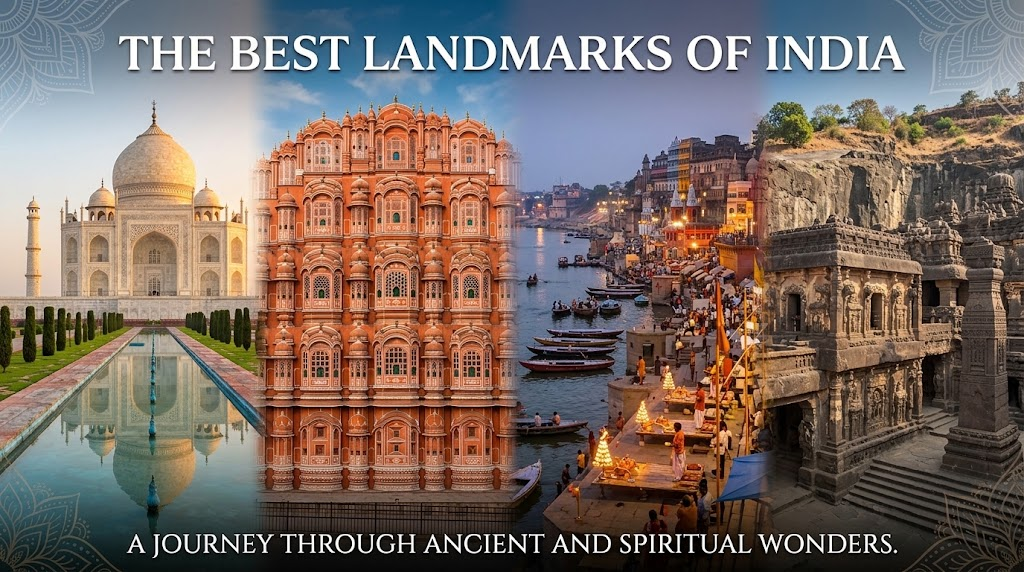
India is a vast and diverse country, offering an unparalleled tapestry of ancient history, stunning architecture, vibrant cultures, and natural beauty. From the snow-capped Himalayas in the north to the serene backwaters in the south, every corner reveals incredible landscapes and structures that tell a story of millennia. For travelers, exploring India’s top landmarks is not just about visiting places; it’s a sensory immersion into a civilizational giant that continuously blends tradition with modern life.
1. The Taj Mahal (Agra, Uttar Pradesh)
No list of Indian landmarks is complete without the Taj Mahal. This monumental white marble mausoleum, a UNESCO World Heritage Site, was commissioned in 1632 by the Mughal Emperor Shah Jahan in memory of his favorite wife, Mumtaz Mahal.
Standing on the banks of the Yamuna River, its sheer scale, symmetry, and architectural grace are breathtaking. While any time of day offers beauty, visiting at sunrise or under the full moon is truly magical, as the white marble reflects the changing light. Beyond the main dome, visitors are mesmerized by the intricate inlay work of semi-precious stones, calligraphy, and surrounding lush Mughal gardens.
2. Varanasi (Uttar Pradesh)
Stepping into Varanasi is stepping into ancient India. One of the world’s continuously inhabited cities, it is the spiritual heart of Hinduism, situated along the sacred Ganges River. Life and death are intertwined on its 87 riverfront ghats.
Navigating the labyrinthine, narrow lanes, listening to the echoing temple bells, and witnessing centuries-old rituals is an overwhelming experience. Key highlights include:
- The Aarti Ceremony: A beautiful evening ritual of fire, music, and chanting held at Dashashwamedh Ghat.
- A Boat Ride on the Ganges: A classic way to witness the sunrise ceremonies and get a unique perspective on the city.
3. Hawa Mahal (Jaipur, Rajasthan)
Located in the historic “Pink City” of Jaipur, the Hawa Mahal, or Palace of Winds, is an architectural marvel of pink and red sandstone. Built in 1799, its unique five-story exterior resembles the honeycomb of a beehive with 953 small windows called jharokhas.
This ingenious design allowed royal ladies to observe daily life on the street below without being seen, and facilitated cool breezes to flow through the palace during Jaipur’s hot summers. The facade, with its intricate latticework, is a stunning backdrop and offers visitors panoramic views of Jaipur City Palace, Jantar Mantar, and busy bazaars.
4. Ellora Caves (Maharashtra)
A short distance from Aurangabad, the Ellora Caves are a monumental achievement of ancient Indian art and architecture. Over a period of five centuries, generations of monks and craftsmen carved complex temples directly into the basalt cliffs, creating a synthesis of three different religions: Buddhism, Hinduism, and Jainism.
The centerpiece and most stunning creation is Cave 16, the Kailasa Temple. It is a single, massive monolithic structure sculpted top-down from a cliff face, designed to represent Mount Kailasa, the abode of Shiva. The level of detail and sheer ambition of carving an entire temple complex out of a single rock is truly awe-inspiring.
Top Indian Landmarks at a Glance
| Landmark | Location | Primary Appeal | Recommended Time |
| Taj Mahal | Agra, Uttar Pradesh | Mughal architecture, romance & beauty | 3 to 4 hours |
| Varanasi Ghats | Varanasi, Uttar Pradesh | Spiritual depth & ancient rituals | 2 to 3 days |
| Hawa Mahal | Jaipur, Rajasthan | Unique architecture & city views | 1 to 2 hours |
| Ellora Caves | Aurangabad, Maharashtra | Masterful ancient rock-cut art | Half-day to Full-day |
From the symmetrical beauty of Agra to the spiritual intensity of Varanasi, exploring India’s classic landmarks provides a profound window into the soul of this remarkable subcontinent.