
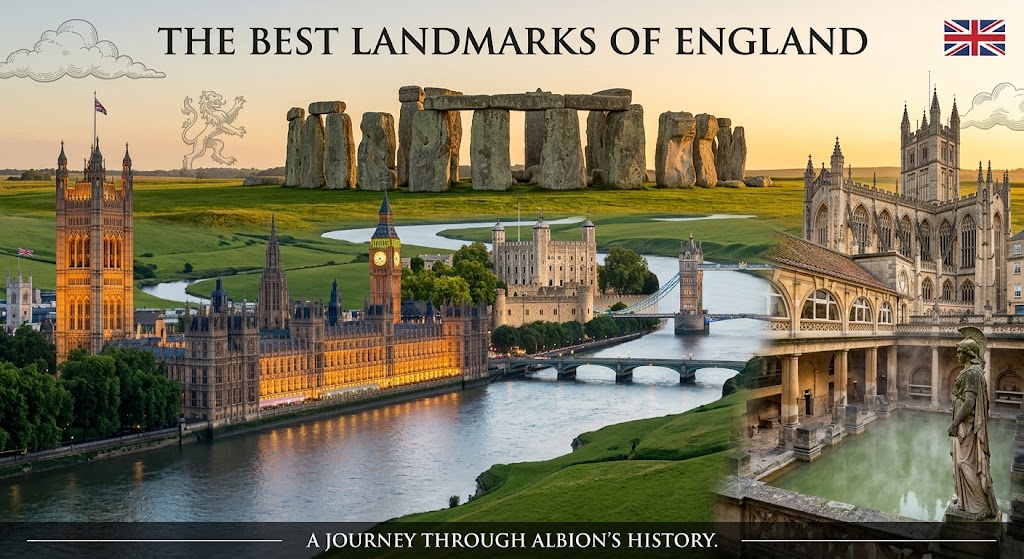
England, a country steeped in history, offers visitors an incredible journey through time. From prehistoric monuments that baffle archaeologists to medieval fortresses and bustling modern cities, its landmarks are globally recognized icons. Exploring these sites is not just about ticking off a list; it’s an immersive dive into the stories, conflicts, and triumphs that have shaped the British Isles and the wider world. Whether you’re drawn to Roman ruins or royal palaces, England’s top landmarks provide an unforgettable experience.
1. Stonehenge (Wiltshire)
Perched on the rolling grasslands of Salisbury Plain, Stonehenge is one of the world’s most famous and mysterious prehistoric monuments. This unique stone circle, a UNESCO World Heritage Site, was constructed over several phases beginning around 3000 BCE. Its precise purpose remains a subject of intense debate, with theories ranging from an astronomical observatory to a religious temple or a burial site. Walking around the monumental stones, especially during a sunrise or sunset, evokes a powerful sense of connection to Britain’s distant past and the ingenuity of its ancient people.
2. Houses of Parliament and Big Ben (London)
Standing on the banks of the River Thames, the Palace of Westminster, better known as the Houses of Parliament, and its attached clock tower, the Elizabeth Tower (home to the bell Big Ben), are definitive symbols of London and the United Kingdom. This Victorian Gothic masterpiece, another UNESCO site, is the center of British political life. Visitors can admire the intricate facade from across the river, or take tours to see the House of Commons and the House of Lords. Big Ben’s chimes have echoed through London for over 150 years, marking time through peace and war.
3. Roman Baths (Bath)
Located in the city of Bath, which is itself a UNESCO World Heritage Site, the Roman Baths complex offers a remarkable glimpse into life nearly 2,000 years ago. Built around Britain’s only natural hot springs, the site was a vital social and religious hub in Roman Britain, known as Aquae Sulis. Today, visitors can see the remarkably preserved Great Bath, explore the museum showcasing Roman artifacts, and see the ruins of the Temple of Sulis Minerva. While you can no longer swim in the original Roman pools, you can experience the geothermal waters at the modern Thermae Bath Spa nearby.
4. Tower of London (London)
Founded by William the Conqueror in 1066, the Tower of London has served as a royal palace, a notorious prison, an armory, a treasury, and the home of the Royal Mint. This historic castle on the Thames is famous for its “Beefeaters” (Yeoman Warders), the ravens whose presence is said to protect the kingdom, and, of course, the Crown Jewels, which are housed and displayed within the complex. Visitors can explore the White Tower, walk along the battlements, and learn the chilling stories of famous prisoners like Anne Boleyn, offering a rich and sometimes dark perspective on British royal history.
Top English Landmarks at a Glance
| Landmark | Location | Primary Appeal | Recommended Time |
| Stonehenge | Wiltshire | Prehistoric mystery & archaeology | 2 to 3 hours |
| Houses of Parliament & Big Ben | London | Government, architecture & city views | 1 to 2 hours (external) |
| Roman Baths | Bath, Somerset | Roman history & natural hot springs | 3 to 4 hours |
| Tower of London | London | Royal history, fortress & Crown Jewels | 3 to 4 hours |
Exploring these landmarks provides a comprehensive introduction to England’s unparalleled depth of history, all set within easily accessible and captivating locations.