
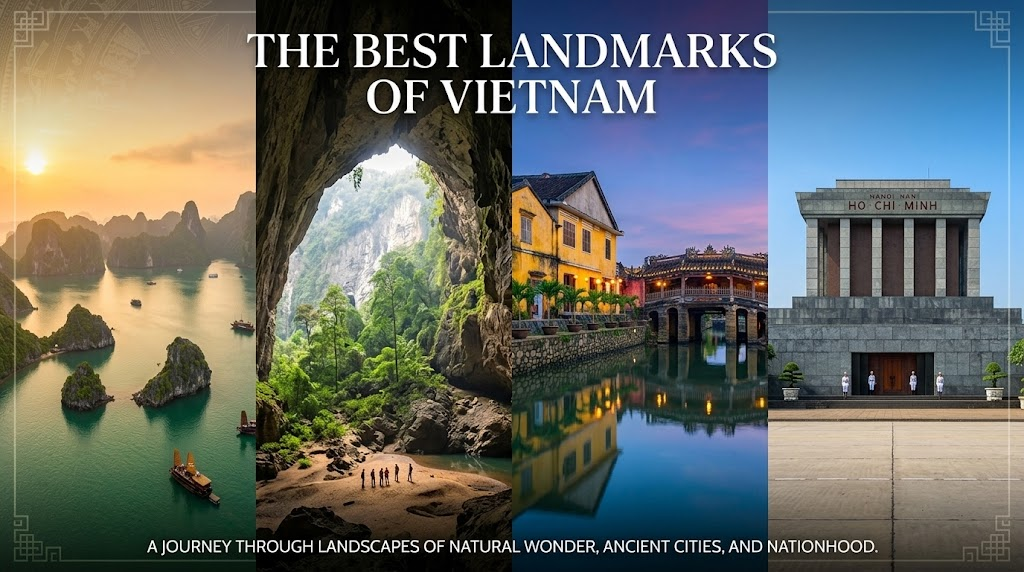
Vietnam, a S-shaped nation on the eastern Indochina Peninsula, is a land of incredible natural beauty, complex history, and a vibrant, resilience-filled culture. From the emerald waters and limestone pillars of its world-famous bays to some of the planet’s largest and most breathtaking caves, and from ancient, culturally rich old towns to modern, dynamic cities, Vietnam’s top landmarks present an unparalleled travel experience. Exploring these sites reveals a nation continuously balancing a deep respect for its heritage with a rapid, forward-looking energy.
1. Ha Long Bay (Quảng Ninh Province)
Ha Long Bay, located in northeast Vietnam, is undoubtedly the country’s most iconic landmark. This UNESCO World Heritage Site is a breathtaking natural seascape defined by thousands of towering limestone karsts and islets that rise dramatically from the emerald waters of the Gulf of Tonkin. Formed over 500 million years, it covers over 1,500 square kilometers and is home to unique ecosystems. A multi-day cruise on a traditional junk boat is the essential way to experience its grandeur, drifting past floating fishing villages, exploring ancient caves (like Sung Sot and Thien Cung), and kayaking around the otherworldly formations.
2. Son Doong Cave (Quảng Bình Province)
Tucked within Phong Nha-Kẻ Bàng National Park, Son Doong Cave is a relatively recent, yet monumental discovery. It was first explored in 2009 and is recognized as the world’s largest known cave. Son Doong is not just a cave; it is an entirely different world, spanning over 9 kilometers in length, with sections reaching 200 meters high and 150 meters wide. Its massive main cavern could fit an entire New York City block with 40-story skyscrapers. The cave’s unique ecosystem, complete with its own river, jungle (the “Garden of Edam”) formed where the cave roof collapsed, and unique ‘cave pearls’, makes it one of the most exclusive and spectacular adventure experiences on Earth.
3. Hoi An Ancient Town (Quảng Nam Province)
Located in central Vietnam, Hoi An Ancient Town is a UNESCO World Heritage Site that perfectly preserves its history as a major Southeast Asian trading port from the 15th to the 19th century. Walking through its narrow, vehicle-free streets is like stepping back in time. The town features a unique blend of Vietnamese, Japanese, Chinese, and French colonial architecture, evidenced by its historic yellow merchant houses, assembly halls, and the iconic Japanese Covered Bridge. After sunset, the entire town is magically illuminated by thousands of colorful lanterns, making the night market along the Hoai River an unforgettable experience.
4. Ho Chi Minh Mausoleum (Hanoi)
In the heart of the national capital, Hanoi, stands the Ho Chi Minh Mausoleum. This imposing marble and granite structure is the final resting place of Ho Chi Minh, the revolutionary leader and founder of modern Vietnam. Built in Ba Dinh Square, where ‘Uncle Ho’ read the Declaration of Independence in 1945, the mausoleum is a deeply revered site for Vietnamese people and a place of immense national significance. Visitors can pay their respects to his embalmed body, which is displayed in the central hall. The surrounding complex includes the Presidential Palace, Ho Chi Minh’s stilt house, and the unique One Pillar Pagoda.
Top Vietnamese Landmarks at a Glance
| Landmark | Location | Primary Appeal | Recommended Time |
| Ha Long Bay | Quảng Ninh, NE | Limestone karsts & emerald waters | 2 to 3 days (cruise) |
| Son Doong Cave | Quảng Bình, Central | World’s largest cave & ecosystems | Multi-day expedition |
| Hoi An Ancient Town | Quảng Nam, Central | Historic architecture & lantern nights | 2 to 3 days |
| Ho Chi Minh Mausoleum | Hanoi | Revolutionary history & national site | 1 to 2 hours |
Vietnam’s landmarks illustrate a story of extraordinary environmental drama, profound historical layers, and a captivating cultural soul.