
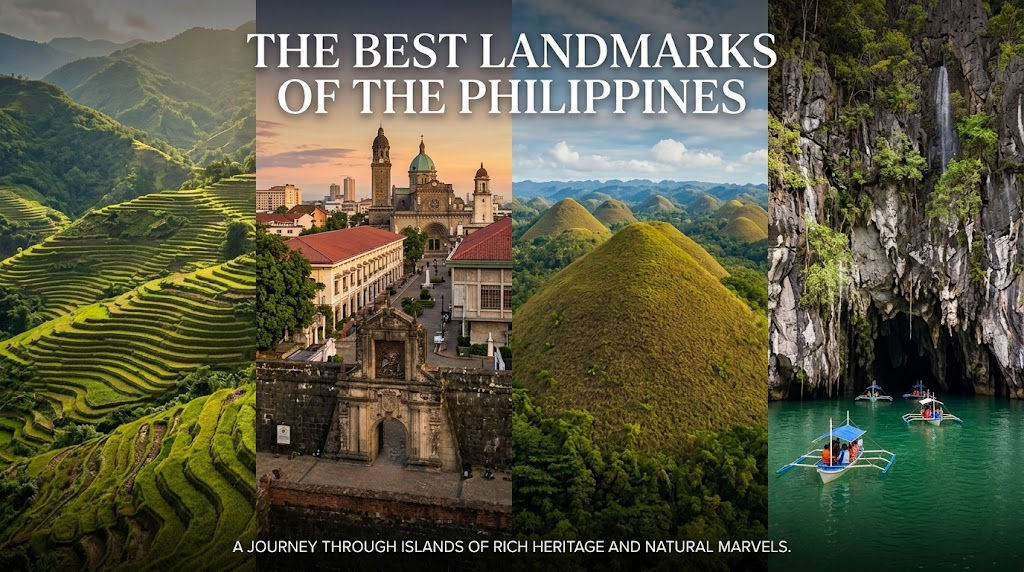
With over 7,000 islands, the Philippines is a Southeast Asian nation defined by dramatic biodiversity, stunning tropical landscapes, and a rich, multi-cultural history. Its landmarks offer a spectacular contrast, from ancient, hand-carved agricultural marvels and otherworldly geological formations to Spanish colonial architecture and pristine, world-renowned beaches. For travelers seeking adventure, cultural depth, and unique natural beauty, the Philippines presents an unforgettable journey through some of the planet’s most unique environments.
1. Banaue Rice Terraces (Ifugao, Luzon)
Often referred to by Filipinos as the “Eighth Wonder of the World,” the Rice Terraces of the Philippine Cordilleras are a monumental feat of human engineering. Carved into the mountainsides of Ifugao by ancestors of the indigenous people over 2,000 years ago, these terraced fields still produce rice today. They are a UNESCO World Heritage Site, recognized as a living cultural landscape. The primary terraces, including those at Banaue, Batad, and Mayoyao, exemplify the harmony between humankind and nature, utilizing an ancient and intricate irrigation system that streams water from rainforests above.
2. Chocolate Hills (Bohol, Visayas)
The Chocolate Hills of Bohol are a unique geological formation, unlike anything else on Earth. Over 1,260 uniform cone-shaped hills are spread across an area of more than 50 square kilometers. Covered in green grass during the wet season, the hills turn a distinct chocolate brown during the dry season, giving them their name. These karstic limestones are believed to be marine deposits lifted above sea level and shaped by centuries of erosion. An elevated viewing deck in Carmen offers the best panoramic perspective of this surreal and enchanting landscape, which is also featured on the provincial seal of Bohol.
3. Puerto Princesa Subterranean River (Palawan)
Located in the Puerto Princesa Subterranean River National Park on Palawan island, this remarkable landmark is a UNESCO World Heritage Site and one of the New 7 Wonders of Nature. The river flows for over 8 kilometers inside a spectacular limestone karst cave system before emptying directly into the South China Sea. Visitors can take guided boat tours that navigate the lower portion of the river. The experience drifts past breathtaking stalactites and stalagmites in massive caverns, offering a glimpse into a complex, hidden ecosystem, while the park itself protects critical old-growth forests and diverse wildlife.
4. Intramuros (Manila, Luzon)
Intramuros, or the “Walled City,” is the oldest and most historic district of Manila. Established in 1571 during the Spanish colonial period, it served as the center of government, religion, and education for over 300 years. Surrounded by massive defensive walls and moats, Intramuros houses several architectural treasures, including Fort Santiago, a former military base and prison; Manila Cathedral, the seat of the Catholic Archdiocese of Manila; and San Agustin Church, the oldest stone church in the Philippines and another UNESCO site. A walk or kalesa (horse-drawn carriage) ride through its cobblestone streets provides an essential perspective on the nation’s deep colonial history.
Top Philippine Landmarks at a Glance
| Landmark | Location | Primary Appeal | Recommended Time |
| Banaue Rice Terraces | Ifugao, Luzon | Ancient engineering & cultural landscape | 2 to 3 days (hiking) |
| Chocolate Hills | Bohol, Visayas | Unique geological formations | Half-day |
| Puerto Princesa Underground River | Palawan | Underground cave & biodiverse ecosystem | Half-day tour |
| Intramuros | Manila, Luzon | Spanish colonial history & architecture | Half-day |
The landmarks of the Philippines reveal a story of environmental drama, indigenous ingenuity, and layered history, all within a captivating tropical archipelago.