
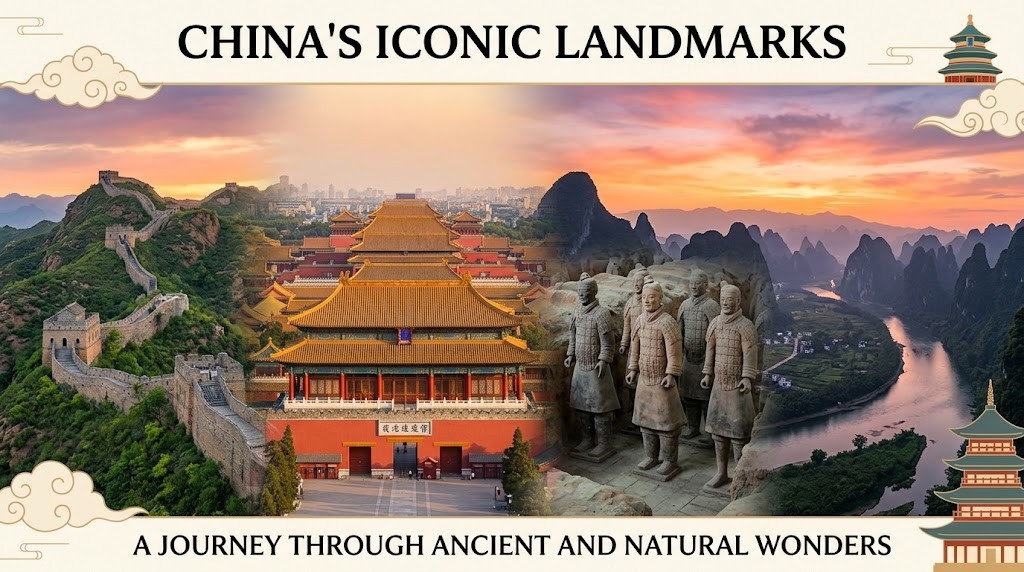
China’s vast landscapes encompass over five millennia of history, architectural marvels, and breathtaking scenery. From ancient imperial compounds to otherworldly natural formations, the country offers travel experiences unlike anywhere else on Earth. Whether you are a history enthusiast or a nature lover, exploring China’s top landmarks reveals the depth and diversity of its remarkable heritage.
1. The Great Wall of China (Beijing & Northern Provinces)
Stretching over 16,000 kilometres across northern ridges, the Great Wall remains China’s most iconic symbol. Built over successive dynasties to protect imperial territories from nomadic invasions, this massive defensive fortification snakes across rugged mountain crests and desert expanses.
While popular sections like Badaling accommodate high visitor volumes, sections such as Mutianyu offer restored watchtowers amidst lush pine forests, complete with cable cars and a toboggan ride down. For adventurous hikers, wilder stretches like Simatai and Jinshanling showcase the wall in its authentic, weathered state against dramatic alpine backdrops.
2. The Forbidden City (Beijing)
Situated in the heart of Beijing, the Forbidden City served as the imperial palace for 24 emperors during the Ming and Qing dynasties (1420–1912). As the world’s largest complex of ancient wooden structures, this UNESCO World Heritage Site spans 180 acres and houses nearly 10,000 rooms.
Entering through the Meridian Gate unveils an imposing expanse of red walls, yellow-tiled roofs, and sweeping marble courtyards. Highlights include:
- Hall of Supreme Harmony: The central stage for grand imperial ceremonies.
- Palace Museum: Home to vast collections of imperial porcelain, jade, calligraphy, and ceremonial dress.
- Jingshan Park: Located just north of the exit, offering panoramic views over the golden rooftops of the entire complex.
3. The Terracotta Army (Xi’an)
Discovered by local farmers in 1974 near Xi’an, the Terracotta Army is considered one of the greatest archaeological finds of the 20th century. Constructed to guard China’s first emperor, Qin Shi Huang, in the afterlife, this subterranean necropolis contains over 8,000 life-sized terracotta soldiers, horses, and chariots dating back to 210 BCE.
What makes the site astounding is its detail: no two soldier faces are identical. Warriors exhibit distinct facial expressions, hairstyles, and armour styles corresponding to their military rank. Pit 1 offers the most impressive view, featuring rows of infantry marshalled in battle formation inside a massive aircraft-hangar-style enclosure.
4. The Li River & Karst Landscapes (Guilin & Yangshuo)
For centuries, Chinese landscape poets and painters have drawn inspiration from the surreal karst topography of Guangxi province. The journey along the Li River from Guilin to Yangshuo drifts past towering limestone spires, bamboo groves, and quiet fishing villages.
A river cruise or a bamboo raft trip along the Xingping stretch reveals scenery so iconic it is featured on the back of China’s 20-yuan banknote. Beyond the water, Yangshuo’s countryside offers rock climbing, cycling through rice paddies, and exploring subterranean limestone caves.
Key Highlights at a Glance
| Landmark | Location | Primary Appeal | Recommended Time |
| Great Wall | Near Beijing | Engineering marvel & scenic hiking | Half-day to Full-day |
| Forbidden City | Central Beijing | Imperial architectural heritage | 3 to 4 hours |
| Terracotta Army | Xi’an, Shaanxi | Ancient history & archaeology | 3 to 4 hours |
| Li River | Guilin / Yangshuo | Natural karst scenery & cruises | 1 to 2 days |
From the imperial magnificence of the northern capitals to the dramatic limestone mountains of the south, China’s classic landmarks highlight why the country remains one of the world’s most compelling destinations.